
Kitchen corners are some of the most difficult areas to use effectively. In an L-shaped or U-shaped kitchen, two cabinet runs meet at an angle, often creating deep spaces that are difficult to reach and easy to ignore. Standard cabinets may technically fill these areas, but they do not always make the storage practical. Pots, appliances, serving dishes, and other items can end up pushed toward the back where they are difficult to see or retrieve.
The good news is that an awkward corner does not have to become wasted space. The right cabinet configuration can transform a difficult area into accessible, organized storage. Depending on the kitchen layout, homeowners can consider options such as Lazy Susan systems, blind-corner pull-outs, diagonal corner cabinets, deep drawers, appliance storage, or even intentionally closed-off corners.
The key is choosing a solution based on the actual dimensions, cabinet type, traffic flow, and way the kitchen is used. This guide explores the Best Cabinet Solutions for Awkward Kitchen Corners and explains how custom cabinetry can make difficult spaces more functional without compromising the overall design.
Why Kitchen Corners Become Difficult Storage Areas
Corner cabinets are challenging because the available interior space is often deeper than the cabinet opening. Once two cabinet runs meet, part of the storage can become difficult to access from the front. A standard cabinet may provide plenty of cubic space on paper, but usable storage depends on how easily you can reach the items inside. If retrieving a heavy pot requires moving several other objects first, the cabinet is not functioning efficiently.
The problem becomes even more noticeable in kitchens with:
- L-shaped or U-shaped layouts
- Large corner base cabinets
- Narrow cabinet openings
- Deep storage areas
- Limited clearance around appliances
- Older cabinet configurations
- Irregular wall dimensions
This is why the Best Cabinet Solutions for Awkward Kitchen Corners should be selected according to the specific corner rather than treating every kitchen corner the same way.
Identifying the Type of Awkward Corner Before Choosing a Cabinet Solution
The first step is understanding what kind of corner you have. A diagonal corner cabinet and a blind corner cabinet may look similar from a distance, but their internal configurations and storage options are different.
A blind corner cabinet extends behind an adjoining cabinet run, leaving part of the interior hidden from the primary opening. A diagonal or pie-cut corner cabinet instead faces the room at an angle and can accommodate rotating shelves or other corner storage systems.
This distinction matters because the hardware designed for one configuration may not work properly in another. Before selecting an organizer, the cabinet width, opening, depth, adjacent cabinets, appliance locations, and available door clearance should be evaluated. For custom cabinetry projects, these measurements can be incorporated into the cabinet design from the beginning instead of trying to correct an inefficient corner after installation.
Best Cabinet Solutions for Awkward Kitchen Corners
There is no single solution that works for every kitchen. The right choice depends on whether the priority is maximum storage, easy access, visual simplicity, budget control, or a combination of these factors.
Lazy Susan Cabinets for Easy Rotating Access
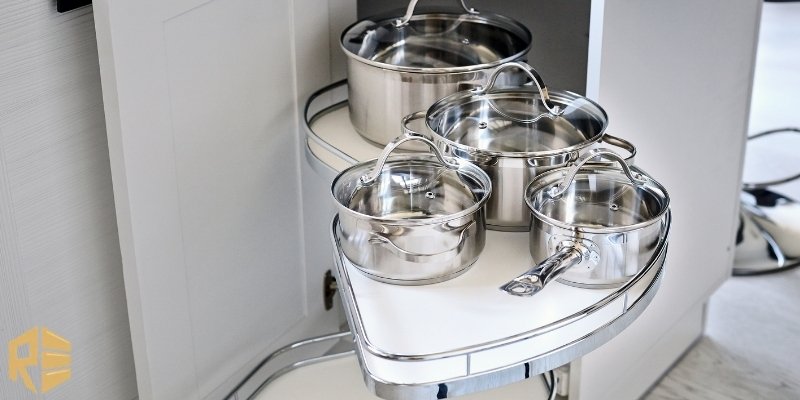
Lazy Susan systems remain one of the most recognizable solutions for corner cabinets. Instead of requiring homeowners to reach deep into the back of the cabinet, rotating shelves bring stored items toward the opening.
Different configurations can include full-round, kidney-shaped, or other rotating shelf designs depending on the cabinet construction. They can work particularly well when the corner cabinet is designed specifically to accommodate the rotating mechanism. The major advantage is accessibility. Items stored toward the back can be brought forward simply by rotating the shelf. This makes the system useful for cookware, serving pieces, pantry items, and other objects that would otherwise disappear into the corner.
However, the design should be selected carefully. Shelf shape, cabinet dimensions, door movement, and hardware quality all affect how smoothly the system operates.
Blind-Corner Pull-Out Systems for Maximum Accessibility
A blind corner can be one of the most frustrating areas in a kitchen because part of the cabinet is hidden behind the adjacent run. Pull-out mechanisms are designed to address this problem by bringing storage toward the user.
Some articulated systems allow shelves to move outward and then across the opening, making items stored deeper inside considerably easier to access. This approach can be particularly useful for homeowners who frequently use the corner for cookware or other heavy kitchen items.
The main benefit is not necessarily adding more storage. It is improving access to the storage that already exists. A smaller amount of usable storage that can be reached easily is often more practical than a large cabinet that requires reaching, bending, and moving other items.
Diagonal Corner Cabinets for a More Open Interior
A diagonal corner cabinet changes the geometry of the corner by positioning the cabinet face at an angle. This configuration can create a more direct opening into the corner and can work well with rotating storage accessories.
The diagonal face can also create a visual transition between two cabinet runs. In traditional and transitional kitchens, this configuration may feel more integrated with the overall cabinet design. For modern kitchens, the decision should also consider whether the homeowner prefers a continuous run of cabinetry or is comfortable with a visible angled cabinet face.
Deep Drawers Instead of Traditional Corner Storage
In some layouts, the best solution is not a specialized corner mechanism at all. If the kitchen design allows the corner to be reconfigured, deep drawers in nearby cabinet sections can provide easier access to frequently used items.
Drawers are particularly effective for cookware, dishes, utensils, and other heavy objects because the contents are visible when the drawer is opened. Instead of reaching into a deep cabinet, the homeowner can pull the entire storage area toward them.
This strategy can be especially useful when the corner itself has limited accessibility. Rather than spending heavily on complicated hardware, the design can focus storage capacity in areas that are easier to use.
Appliance or Pantry Storage Near the Corner
An awkward corner can also influence the placement of appliances and pantry storage. Depending on the floor plan, the space surrounding the corner may be better used for a tall pantry, appliance cabinet, or dedicated storage zone.
For example, a custom cabinet layout can provide a designated location for a countertop appliance that would otherwise occupy valuable workspace. Similarly, a tall pantry can organize dry goods without forcing homeowners to rely on a deep corner cabinet.
The important point is to consider the entire cabinet wall rather than trying to solve the corner in isolation.
Comparing the Most Practical Corner Cabinet Solutions
The following comparison can help homeowners understand how different solutions approach the same storage problem.
| Cabinet Solution | Best For | Accessibility | Storage Character | Design Consideration |
|---|---|---|---|---|
| Lazy Susan | Diagonal corner cabinets | High | Rotating shelves | Requires compatible cabinet geometry |
| Blind-Corner Pull-Out | Deep blind corners | Very High | Pull-out shelves | Needs accurate measurements and clearance |
| Diagonal Corner Cabinet | L-shaped layouts | High | Open corner storage | Creates an angled cabinet face |
| Deep Drawers | Frequently used cookware | Very High | Drawer-based storage | May require layout changes |
| Pantry Cabinet | Dry goods and appliances | High | Vertical storage | Uses wall height efficiently |
The table shows an important principle: the most sophisticated mechanism is not automatically the best answer. A corner that is rarely used may not justify expensive hardware, while a corner used every day may benefit from a more accessible pull-out system.
How Custom Cabinet Design Solves Difficult Corner Problems
Standard cabinets are manufactured around predetermined dimensions. That can make it difficult to accommodate unusual wall lengths, narrow gaps, architectural features, or specific storage requirements. Custom cabinetry takes a different approach by starting with the room itself. Cabinet dimensions can be developed around the available space, appliance locations, windows, doors, ceiling height, and the homeowner’s storage habits. This is especially useful when a kitchen contains multiple difficult areas rather than one isolated corner.
A custom designer can consider:
- Exact wall and cabinet dimensions
- Door and drawer clearance
- Appliance placement
- Countertop depth
- Traffic flow around the island
- Frequently used versus rarely used storage
- Hardware and organizer requirements
- Visual continuity between cabinet sections
Reza Custom Cabinet designs cabinetry around the layout, storage requirements, materials, finishes, and budget of each project and provides custom kitchen cabinet services throughout San Diego County.
Choosing Corner Storage Based on How You Use Your Kitchen
The best corner cabinet solution should reflect what actually happens in the kitchen. If the corner will hold large pots and pans, accessibility and weight capacity become important. If it will store serving dishes that are used only occasionally, a simpler configuration may be sufficient.
Homeowners who cook frequently may prefer pull-out or rotating systems because they reduce the need to reach deep into the cabinet. A household that prioritizes a minimalist appearance may prefer a simpler cabinet configuration that keeps the exterior visually continuous. The location of the corner also matters. A cabinet directly beside a dishwasher, refrigerator, range, or island may have different clearance requirements from a corner located at the end of a cabinet run. This is why the Best Cabinet Solutions for Awkward Kitchen Corners should be determined as part of the complete kitchen layout rather than selected as an isolated accessory
Common Mistakes to Avoid When Designing Corner Cabinets
One common mistake is choosing a storage mechanism before checking the available dimensions. Corner hardware needs sufficient space to open, rotate, or extend without hitting adjacent cabinets or appliances.
Another mistake is prioritizing maximum cabinet volume over accessibility. A very deep cabinet may technically hold a large number of items, but if most of that space is difficult to reach, the storage will not perform well in daily use.
Homeowners should also avoid ignoring the countertop and door swing. The cabinet mechanism, countertop overhang, door position, and adjacent appliances must work together.
Finally, corner storage should not be considered separately from the rest of the kitchen. A solution that looks efficient on paper may create an awkward workflow if it interferes with preparation space or movement between work zones.
Affordable Custom Cabinets Can Still Include Smart Corner Storage
Custom cabinetry does not necessarily mean adding expensive mechanisms to every cabinet. A thoughtful design can prioritize the areas where specialized storage provides the greatest practical benefit.
Homeowners researching Affordable custom cabinets San Diego can focus their budget on high-use features such as accessible corner storage, deep drawers, pantry organization, or specialized appliance cabinets while using simpler configurations in low-use areas. This approach creates a more balanced project. Instead of paying for premium hardware everywhere, the budget is directed toward features that genuinely improve the kitchen’s functionality.
Corner Cabinet Design for Different San Diego Homes
San Diego kitchens vary considerably in architectural style, room size, and homeowner preferences. A compact kitchen may need to maximize every inch, while a larger home may prioritize visual balance and seamless cabinetry. For homeowners considering Custom cabinets in del mar, corner storage can also be designed to complement the overall architectural character of the property while addressing practical storage requirements.
Whether the kitchen has a modern, transitional, coastal, or traditional aesthetic, the cabinet solution should feel like part of the original design. Reza Custom Cabinet serves homeowners across San Diego County and develops cabinetry around individual layouts and storage needs.
A Practical Process for Fixing an Awkward Kitchen Corner
The most effective approach begins with an evaluation of the existing kitchen. Measurements should be taken before deciding which corner mechanism or cabinet configuration is appropriate. Next, the homeowner’s storage habits should be discussed. Knowing what will actually be stored in the corner helps determine whether rotating shelves, pull-outs, drawers, or a simpler cabinet configuration makes sense. The design should then be reviewed as a complete kitchen layout. Appliance clearances, cabinet doors, drawers, countertops, walkways, and adjacent storage all need to work together.
Finally, accurate fabrication and professional installation are essential. Corner mechanisms depend on precise cabinet construction and alignment. Even a good storage system can perform poorly if the cabinet is not square or the hardware is installed incorrectly.
Conclusion
Awkward kitchen corners do not have to become wasted or difficult-to-access spaces. The right cabinet solution depends on factors such as the shape of the corner, available clearance, storage needs, and how you use your kitchen every day. Options such as Lazy Susan cabinets, blind-corner pull-outs, diagonal cabinets, deep drawers, and pantry cabinets can make these areas much more practical.
Custom cabinet design also makes it possible to accommodate unusual walls, appliances, windows, and existing layouts instead of forcing a standard cabinet into a space where it does not fit properly. With careful planning of dimensions, hardware, accessibility, and finishes, an awkward corner can become an organized and functional part of the kitchen rather than a persistent storage problem.
Frequently Asked Questions About Awkward Kitchen Corners
- What is the best cabinet solution for a blind kitchen corner?
The answer depends on the cabinet dimensions and how frequently the space will be used. Blind-corner pull-outs can improve access significantly, while simpler solutions may be appropriate for storage that is rarely accessed.
- Is a Lazy Susan good for kitchen corner cabinets?
Yes. Lazy Susan systems can make rotating corner storage much easier to access. They are particularly suitable for compatible diagonal or dedicated corner cabinet configurations.
- Can an existing corner cabinet be upgraded?
In some cases, existing cabinets can accommodate upgraded organizers or pull-out systems. However, compatibility depends on the cabinet construction, dimensions, opening size, and available clearance. A professional assessment is recommended before purchasing hardware.